Friday, February 20, 2015

ACA Announces Pasadena Endorsements

PASADENA, CA — After a careful evaluation of the candidates and personal interviews, the Armenian Council of America is pleased to announce the endorsement of Mr. Terry Tornek for Mayor of Pasadena, incumbents Margaret McAustin for Pasadena City Council District 2 and Gene Masuda for Pasadena City Council District 4, both of which are running unopposed, and Roy Boulghourjian for Pasadena Unified School District 2.


Mr. Tornek has lived in Pasadena since 1982, when he accepted the position of Planning Director. Mr. Tornek was the author and leader of the City of Pasadena plan to transform and rehabilitate Old Pasadena, preserving almost 200 historical buildings, which form the historic downtown identity of Pasadena.


After leaving city government, Mr. Tornek built a career in real estate, as a developer and manager of residential and commercial properties. He remained active in Pasadena affairs, through his 20 year service as a Board Member of Pasadena Neighborhood Housing Services. In 2005, Mr. Tornek was appointed to the Pasadena Planning Commission. He also served as a member of the Design Commission.


Mr. Tornek was first elected to represent Pasadena City Council District 7 in April, 2009 and re-elected in 2013.


Mr. Tornek currently serves on the Municipal Services and Finance Committees. He is the City Council appointee to the Fire and Police Retirement Board, Pasadena’s representative to the San Gabriel Valley Council of Governments and is Treasurer of the Burbank Airport Authority. He has been deeply involved in the revisions to the General Plan and in advocacy to redirect the City’s planning and development decision-making process. He has also been pursuing efforts to restructure the City’s traffic management and water conservation practices.


Mr. Tornek has a degree in Public & International Affairs from Princeton University’s Woodrow Wilson School and a Master of Science in Urban Planning from Columbia University’s School of Architecture.


Terry and his wife Maria have been married for 46 years. They have 3 children and 7 grandchildren.


Margaret McAustin and Gene Masuda have both served as City Councilmembers and have exemplified their stances on issues of importance to the Armenian American community in Pasadena. These issues include maintaining the integrity and character of our single family residential neighborhoods of Pasadena, fighting crime, decreasing traffic, parking congestion and speeding, protecting open space, improving Pasadena public schools and keeping the commercial areas appealing for investment. Both have maintained a good relationship with their Armenian American constituency and have had an open door policy towards understanding the needs and concerns of the community.


Mr. Roy Boulghourjian has lived in Pasadena since 1985 and has worked as an educator for over 27 years. He started by teaching high school math and economics. He then served as a vice principal and co-founded an early learning school. He currently works as a math and economics professor and serves as the business and general education department Chair at Mt. Sierra College.


The City of Pasadena and Pasadena Unified School District election will be held on March 10, 2015. For more information, and to find your polling place please visit the Pasadena City Clerk’s website.


The Armenian Council of America is a grassroots organization dedicated to working with all political leaders, offering Armenian related news, analysis and resources for policymakers, media, students and activists, advocating issues important to Armenian Americans. The Armenian Council of America aims to strengthen U.S. – Armenia and U.S. – Nagorno Karabakh ties, the development of programs promoting sustainable economic growth and good governance in Armenia, while promoting the values and responsibilities of global citizenship.


ACA Announces Pasadena Endorsements

Turkish Intellectuals Who Have Recognized The Armenian Genocide Ayşe Berktay

By Hambersom Aghbashian


AyÅŸe Berktay is a translator, scholar, author, cultural and women’s rights activist. Her publications include “History and Society: New Perspectives, 2008″, and “The Ottoman Empire and the World Around with Suraiya Faroqhi”; moreover, she is the editor of “Women and Men in the 75th Year of the Turkish Republic”. Her translations include “The Imperial Harm: Gender and Power in the Ottoman Empire, 1520-1656″ by Leslie Penn Pierce; and “The Ottoman Empire, 1700-1922 ,New Approaches to European History” by Donald Quataert.


Over the past decade, AyÅŸe conducted work at the History Trust, where she was part of the Prime Minister’s Advisory Board on Human Rights. In Dec. 2009 AyÅŸe became a member of the pro-Kurdish Peace and Democracy Party (BDP), which has 36 elected representatives in the Turkish Parliament. In March 2010 she was elected to the BDP Istanbul Province Executive, where she worked in the Press Committee, then in Oct. 2010 she was elected to the BDP Central Women’s Committee, Foreign Relations Office. AyÅŸe Berktay was arrested on October 3, 2011, and seized personal papers and materials. Eventually, she was charged under Turkey’s anti-terror legislation of “membership in an illegal organization”. She was released from Prison in Istanbul on Dec. 20, 2013 and still faces a lengthy trial process, where she could face up to 15 years in prison. (1)


In December 2008, two hundred prominent Turkish intellectuals released an apology for the “great catastrophe of 1915″. This was a clear reference to the Armenian Genocide, a term still too sensitive to use so openly. The signatories also announced a website related to this apology, and called on others to visit the site and sign the apology as well. The complete, brief text of the apology says “My conscience does not accept the insensitivity showed to and the denial of the Great Catastrophe that the Ottoman Armenians were subjected to in 1915. I reject this injustice and for my share, I empathize with the feelings and pain of my Armenian brothers and sisters. I apologize to them.” AyÅŸe Berktay was one of the Turkish intellectual who has signed the petition. (2)


AyÅŸe Berktay was one of the Turkish intellectuals who signed a petition against Denialist Exhibit in Denmark, an exhibition which was planned by the Turkish embassy to support their point of view concerning the Armenian Genocide .” Don’t Stand Against Turkey’s Democratization and Confrontation with its History!” was the message to the Royal Library of Denmark who has given the Turkish government the opportunity to present an “alternative exhibit” in response to the Armenian Genocide exhibition.(3)


In the 99th anniversary of the Armenian Genocide, the members of the 24 April Commemorating Armenian Genocide Platform came together in front of the historical HaydarpaÅŸa Railhead to commemorate the Armenian intellectuals who were put in trains from HaydarpaÅŸa Railhead in 1915 and sent to death. The citizens left red carnations on the placards writing in both English and Armenian reading “We are remembering the victims of Armenian genocide” and they carried the photos of Armenian intellectuals. The Peoples’ Democratic Party (HDP) Central Executive Board (MYK) member Garo Paylan, Author AyÅŸe Berktay, Academiscian Fatmagül Berktay, Human Rights Association (İHD) İstanbul Branch Head Ümit Efe, İHD executives, Armenians coming from Diaspora; and lots of citizens joined in the commemoration activity.(4)

—————————————

1- http://www.pen.org/defending-writers/ay%C5%9Fe-berktay

2- http://www.armeniapedia.org/wiki/200_prominent_Turks_apologize_for_great_catastrophe_

3- http://www.armeniapedia.org/wiki/The_Armenian_Genocide_and_the_Scandinavian_Respon

4- http://www.diclehaber.com/en/news/content/view/398100?page=11&from=314584322


Turkish Intellectuals Who Have Recognized The Armenian Genocide AyÅŸe Berktay

Congratulatory Address in Connection with the Artsakh Revival Day

The Address of President Bako Sahakyan in connection with the Artsakh Revival Day


Dear compatriots,


On behalf of the Artsakh Republic authorities and myself personally I cordially congratulate you on this significant state holiday – the Artsakh Revival Day.


27 years ago on this very day the course of our nation’s history changed fundamentally and a new period marking the revival of the independent Armenian statehood began. The Armenian people who survived without statehood for centuries and for this reason undergone great ordeals eventually managed to unite all the forces and stand to protect their violated rights and freedoms. It was a powerful national outburst that had been maturing over centuries and which was already impossible to squash.


One idea, one body, one fist: that is how an Armenian appeared before the world in the historical 1988. That strong and unshakable unity and solidarity led our people to victories that we have dreamed of for centuries.


Today all of us, every Armenian, on a daily basis must do everything possible to secure the victories won by the holy blood of our perished heroes. Such a historic opportunity was given to our generation and we must do everything possible to achieve our ultimate goal – together, shoulder to shoulder build a strong, developed and prosperous Motherland, which is one for all the Armenians.


Dear people of Artsakh,

I once again congratulate all of us and wish peace, robust health, great successes and new victories for the heroic Artsakh and our people.


Stepanakert,

February 20, 2015.


Congratulatory Address in Connection with the Artsakh Revival Day

Florida Atlantic University Conducts First Public Teacher Workshop on the Armenian Genocide in South Florida

By Taniel Koushakjian
FLArmenians Managing Editor


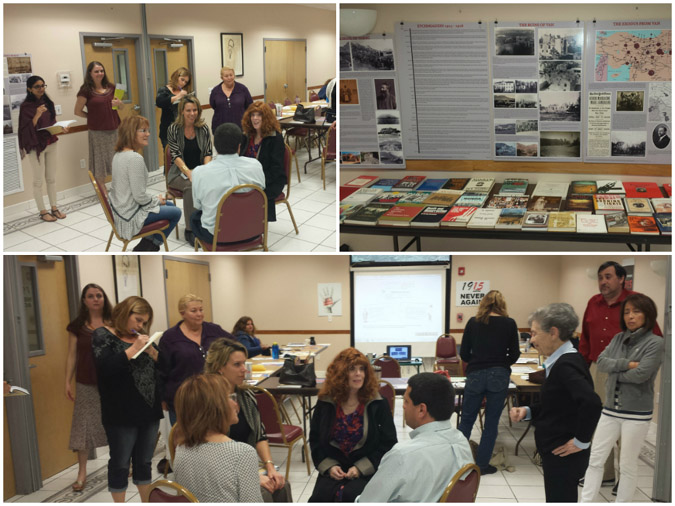
As part of the South Florida commemorations of the Armenian Genocide, the first genocide of the 20th century, Florida Atlantic University (FAU) will conduct a two-part series of events. On January 20th, Dr. Rosanna Gatens, Director of the Center for Holocaust and Human Rights Education (CHHRE) at FAU and Reverend Fr. Paren Galstyan, Pastor of St. David Armenian Church in Boca Raton, Florida, held a workshop at the Alex and Marie Manoogian School. The workshop featured lectures, exhibits, and thought-provoking information and dialogue on the Armenian Genocide. Facilitated by Dr. Mary Johnson, Facing History and Ourselves, the workshop explored the role of World War I in the execution of the Armenian Genocide in the Ottoman Turkish Empire.


Fifteen teachers from Broward and Palm Beach County participated in the FAU workshop. “St. David’s Armenian school was the perfect setting for teachers, not only to learn about the Armenian genocide and how to teach it, but also to begin to understand Armenian identity,” stated Dr. Gatens. “All of us were fascinated by the richness of Armenian culture, but even more by the ancientness of Armenian Christianity,” Dr. Gatens said.


FAU AG Workshop C1During the workshop instructors examined the exhibit “Witness to the Armenian Genocide: Photographs by the Perpetrators’ German and Austro-Hungarian Allies,” produced by the Armenian National Institute (ANI), the Armenian Genocide Museum of America (AGMA), and the Armenian Assembly of America (Assembly). The ten-poster set includes an introductory page, a detailed timeline, a color-coded map geographically matching the photographs with their location, and seven pages displaying 34 captioned historic photographs. The color-coded map in the exhibit is based on the previously-published ANI map of the 1915 Armenian Genocide in the Ottoman Turkish Empire illustrating the three prevailing aspects of the Genocide: the deportations, the massacres, and the concentration camps.


FAU’s second lecture commemorating the 100th Anniversary of the Armenian Genocide will take place on Sunday, April 19, 2015, as part of the Martin and Edith Stein Community Lecture Series. Dr. Tamar Açkam will discuss his book, “The Young Turks’ Crime Against Humanity: The Armenian Genocide and Ethnic Cleansing in the Ottoman Empire.” Dr. Açkam is the Robert Aram, Marianne Kaloosdian and Stephen and Marian Mugar Chair in Armenian Genocide Studies at Clark University in Worcester, Massachusetts.


Florida Atlantic University Events Commemorating the 100th Anniversary of the Armenian Genocide:


Florida Atlantic University Conducts First Public Teacher Workshop on the Armenian Genocide in South Florida

Eurovision Song Contest 2015: Tamar Kaprelian from US Second Member of Genealogy Group

YEREVAN — Tamar Kaprelian is the second member of the band Genealogy, representing Armenia in the 2015 Eurovision Song Contest with “Don’t Deny”. Born and raised in the US, she will represent the continent of America in the project. After Essaï Altounian from France, Tamar Kaprelian is the second artist of the band to be announced.


Tamar Kaprelian is an Armenian American musician and singer. She is best known for her single “New Day” and for winning the OneRepublic “Apologize” Cover Contest in March 2008. Since 2010, Tamar has released a full length album titled “Sinner Or A Saint” and a very personal EP titled “California”. It was one of the first released from Universal’s Killer Tracks Artist Series, an innovative and non-traditional platform created to help artists reach new audiences and explore new revenue opportunities. Returning back to the studio, Tamar is wrapping up her follow-up 5 song EP with Killer Tracks, available in May 2015.


tamar-EPTamar is currently residing in New York City and with honest and uplifting songs, she takes listeners on a journey across the arcs of relationships and personal growth.


“To be included in this competition at a special time when we are commemorating such a landmark anniversary for Armenia is an amazing privilege for me. I am so excited to be joining a very talented group of artists to represent Armenia and America, and to share a positive message about peace and unity with the audiences”. Tamar Kaprelian stated.


Armenian Public TV Company has announced earlier that Genealogy will be uniting the new generation of Armenians spread through 5 continents (Europe, Asia, America, Africa, and Australia) around the world in the year of 1915. The group consists of 6 artists with Armenian origin – 6 destinies with 1 story.


Tamar’s interest in music began when she discovered the works of Billy Joel and Paul McCartney at a young age. Tamar started writing songs when she was 14, and she began playing the piano without formal training, and learning by simply picking up the instrument solely by ear.


Through a Youtube cover contest, she became known by Interscope Records, which signed her. Shortly afterwards “New Day” was released and it became her debut album’s first single. Sinner Or A Saint was a classic pop album of thought-provoking, hopeful, playful, and honest songs. It’s a coming-of-age record that chronicles Tamar’s life, relationships, and her utter determination to create an album that is real and true to herself, both personally and artistically


Eurovision Song Contest 2015: Tamar Kaprelian from US Second Member of Genealogy Group

President Sarkisian Says Ready to Invite Ter-Petrosian for Meeting

YEREVAN — Armenian President Serzh Sarkisian has expressed his readiness to invite ex-president Levon Ter-Petrosian for a meeting after the latter published a critical article and offered to meet him to discuss a number of aspects of a recently adopted pan-Armenian declaration on the approaching Genocide Centennial.


Ter-Petrosian first published an article on February 11 voicing criticism regarding some aspects of the declaration that was recently adopted by a high-level commission planning and coordinating upcoming commemorations of the 100th anniversary of the Armenian Genocide.


He, in particular, criticized Sarkisian, who heads the commission, as well as leaders of Armenian Diaspora organizations for essentially laying territorial claim to Turkey. The ex-president specifically pointed to a declaration passage which says that Armenia and its worldwide Diaspora will strive to not only get more countries to condemn the slaughter of 1.5 million Ottoman Armenians but also “overcome consequences of the genocide.” In that context, it refers to the 1920 Treaty of Sevres that envisaged Armenian control over much of what is now eastern Turkey.


In a follow-up ‘open letter’ to Sarkisian that Ter-Petrosian said was originally planned for publication on February 13 but appeared in media only four days later – because of the standoff that began last week between Sarkisian and Ter-Petrosian’s key opposition ally, Gagik Tsarukian – the ex-president offered a “tete-a-tete meeting” with the current head of state to discuss the mentioned aspects of the declaration as well as other related issues. He also proposed the establishment of a separate commission that would “finalize the position of the Republic of Armenia in the Genocide issue.”


In an addition to the original text of the article that Ter-Petrosian said had been written before the inception of the internal political standoff he regretted that it was impossible to realize his idea “in conditions of the political revenge and fierce violence unleashed against Gagik Tsarukian, the Prosperous Armenia Party and the opposition in general.”


In a reply open letter made available to the media on Friday President Sarkisian categorically rejected Ter-Petrosian’s evaluations of the pan-Armenian declaration, in particular, his claim that it contradicts the Constitution of Armenia and international legal documents. Still, he said, considering that “there will be numerous proposals” to the commission before and after April 24, when the centenary of the Genocide is to be marked, Ter-Petrosian’s proposals should also be discussed.


“You say that there is a need for a tete-a-tete meeting for that purpose. I see no problem,” Sarkisian said, stressing that the internal political reasons cited by Ter-Petrosian for the impossibility of the meeting were “inappropriate”.


“When you find that there is a necessity and desire to discuss events on the occasion of the 100th anniversary of the Armenian Genocide, I am ready to send you a corresponding invitation,” President Sarkisian concluded.


Since its published on February 17, Ter-Petrosian’s open letter to Sarkisian has been construed differently by different political parties. While representatives of Sarkisian’s ruling Republican Party mainly welcomed the initiative, some in the opposition camp called it “a stab in the back” against Tsarukian and his Prosperous Armenia Party.


But Ter-Petrosian’s right-hand man Levon Zurabian argued in an interview with RFE/RL’s Armenian Service (Azatutyun) on Thursday that the HAK leader’s letter was, on the contrary, an attempt to put pressure on Sarkisian to end the crackdown against Tsarukian and his political team.


President Sarkisian Says Ready to Invite Ter-Petrosian for Meeting

Sleeping with Our Enemy: Russia Sells Weapons to Azerbaijan

DavidBoyajianBy David Boyajian


Russia has sold some $4 billion worth of modern weapons to Azerbaijan in the past few years, with perhaps more to come.


These include S-300 air defense missiles, Mi-35M combat helicopters, T-90 tanks, Kornet anti-tank missiles, MSTA-S 152mm self-propelled artillery, and the highly destructive Smerch Multiple Launch Rocket System.


Since Azerbaijan’s 1994 defeat in the Karabakh/Artsakh war, its leaders have declared their intention to seize Artsakh by force. Azeris regularly shoot across, and try to penetrate, Artsakh’s ceasefire line. They have made territorial claims on Armenia and are even shelling villages in Armenia itself.


Armenia and Russia are allies and have a mutual defense pact. Russian troops help guard Armenia’s border with Turkey. Armenia is Russia’s only ally in the Caucasus. Why then is Russia supplying sophisticated weapons to a country that is not just Armenians’ enemy but also hostile to Russian interests?


Selling to the Enemy

Arms sales generate immediate profit for Russia plus continuing income from spare parts and future upgrades. The Russian military may also reason that it knows best how to counter its own weapons should it go to war with Azerbaijan. Perhaps Russia is embedding secret hardware and software vulnerabilities into Azeri weapons to disable them should the need arise.


Russia argues that if it won’t sell weapons to Azerbaijan, other countries will. Yet Baku has bought arms elsewhere: $1.6 billion worth from Israel, including Hermes drones and Spike anti-tank missiles, and significant amounts from Belarus, Turkey, and Ukraine.


By having Azerbaijan partly dependent on Russian weaponry, Moscow presumes it is co-opting Azeris and making them less likely to join NATO and supply gas and oil to the West. Are Azeris really that gullible? Baku could just be buying time until, with Turkey and NATO, it can strike back at Russia’s vulnerable underbelly.


Is Russia selling arms to Azerbaijan because it is unhappy that Armenia has cordial relations with the U.S., EU, and NATO? Probably not. Russia has always found less drastic ways to express its displeasure, such as increasing its natural gas prices.


But Armenians need not worry, says Russia, because it sells defensive weapons to Yerevan, reportedly at reduced prices, which neutralize the offensive ones that Baku buys.


Though Armenians currently hold the military advantage in Artsakh, can defensive weapons really match Azerbaijan’s offensive ones? And can Armenia, whose economy is only 13 to 20% of Azerbaijan’s, afford them? Yerevan may be paying not in cash but rather in factories, infrastructure, real estate, minerals, and debt. That increases Russian’s already considerable control over Armenia. And notice that Russia profits from selling weapons to both sides.


Russian Betrayals

Russia does not, of course, want Azerbaijan (or Turkey) to overrun Armenia. That would create a pan-Turkic corridor from Turkey to Azerbaijan. The U.S. and NATO would use it to dominate the Caucasus, Caspian Sea, and probably Turkic Central Asia.


Artsakh is a different matter. It has no military agreements with Russia. Indeed, Moscow might not care if Azerbaijan overran Artsakh since that by itself would not create a pan-Turkic corridor.


Russia might even want a new Artsakh war if it crippled Azerbaijan’s energy infrastructure and destroyed its gas and oil pipelines that lie just north of Artsakh’s borders. Or, depending on what Baku gives Moscow in return, Russia could even help Azerbaijan defeat Artsakh.


After all, post-WW I, Soviet Russia gave Artsakh and Nakhichevan to Azerbaijan, handed Armenian territory to Turkey, and delivered weapons to Turkish forces under Kemal Ataturk.


Turkey later turned against Russia and eventually joined NATO, while Azeris remained hostile to Moscow. Azeris and Turks outsmarted the Russians.


Some Armenians say that Jewish Bolsheviks, unlike the Russian Orthodox nationalists who allegedly control Russia now, were mainly responsible for those disasters.


Nevertheless, arms sales to Azerbaijan and Moscow’s massive trade and natural gas deals with Turkey remind Armenians of past Russian betrayals.


Armenia and Artsakh’s Security

To hedge against more Russian betrayals, and for economic, scientific, educational, and religious-cultural reasons, Armenia understandably maintains friendly relations with the U.S. and Europe.


Armenia cannot, however, look to the U.S. and NATO for military security. The latter regard Turkey as not only weightier than Armenia, but also as the horse on which to gallop into the Caucasus, Caspian, and beyond. Therefore, Armenia allies itself with Russia. Without Armenia, of course, Russia will lose the Caucasus and much more to NATO.


As Moscow aspires to someday be the leader of all Eurasian countries, it is attempting – in vain, undoubtedly – to lure Turkey and Azerbaijan away from a Western orientation. Failing that, Russia hopes such relations will produce short- to medium-term economic and political gains. For Russia’s own sake, it should examine its past pro-Turkic missteps.


Armenia and Russia will probably remain in a cycle of mutual need and suspicion for some time.


As Armenia and Artsakh face the future, therefore, deeper insight into Russian strategy and intentions is essential.


# # #


David Boyajian is a freelance Armenian American journalist. Many of his articles are archived at Armeniapedia.org.


Sleeping with Our Enemy: Russia Sells Weapons to Azerbaijan