Friday, May 9, 2014

Bako Sahakyan: Liberation of Shoushi Laid the Ground for All Future Achievements

STEPANAKERT — On May 9 Artsakh Republic President Bako Sahakyan issued a congratulatory address in connection with the Victory Day, the Day of the NKR Defense Army and the Liberation of Shoushi. The message reads:


“Dear compatriots,


Dear veterans of the Great Patriotic and Artsakh Liberation Wars,


On behalf of the Artsakh Republic authorities and on my own behalf, I cordially congratulate you on the Victory Holiday, the Day of the Nagorno Karabagh Republic Defense Army and the Liberation of Shoushi.


May 9 is among the most memorable holidays in the Armenian history, which symbolizes patriotism intrinsic to our national character and courage, self-sacrifice and feat, unshakable will and resoluteness to rebel and win against foreign yoke. It goes back deep into history and manifested itself during the Great Patriotic War when our fathers and grandfathers together with different nations fought against the Nazi Germany to save the world from the clutches of Nazism. The new generation continued their heroic lesson defending the native land and annealing victories in the Artsakh Liberation Wars.


The formation of the Defense Army and the liberation of Shoushi became crucial achievements that have laid the ground for all of our future successes. Along with our brothers and sisters from Armenia and the Diaspora we managed not only to win during the imposed on us hard and cruel war, but also build a steadily flourishing and developing country thus continuing the unfinished mission of the brave sons of the Armenian people, who perished for Motherland, perpetuating their memory.


Dear compatriots,


I once again congratulate all of us with this glorious Triple Day and wish peace, prosperity and new victories to our heroic people and Motherland.”


Bako Sahakyan: Liberation of Shoushi Laid the Ground for All Future Achievements

Genocide Survivor Yevnige Salibian Honored By Steven Spielberg and Shoah at 20th Anniversary Gala

By Talin Bahadarian


Fleeing Aintab, Turkey in 1921 at the age of 7, little did my Grandma, Yevnige Aposhian Salibian, know that her story of survival from the Armenian Genocide would be her golden ticket to attend the USC Shoah Foundation Gala as a distinguished guest on May 7, 2014.


It’s a Cinderella story, where like the princess in the classic story, Yevnige Salibian was whisked away from her former life in a horse drawn carriage at a young age, escaping oppression. And in both stories, they ended up at a ball. For Cinderella it was the ball in honor of the prince. For Grandma, it was 93 years later at a gala in honor of the President, a recipient of the Ambassador for Humanity award.


Her adventure that evening began as Ararat Home COO Derik G. Ghookasian, Ararat Home Museum Director Maggie Goschin, Grandma and I maneuvered through the streets of Century City, trying to make our way to the Century Plaza hotel, a seemingly impossible feat with all the road closures due to the presidential arrival. Grandma, not getting out much in the last decade or so, took in all the sights in an almost gleeful child-like fashion, commenting on the height and architecture of the buildings, the beautiful trees lining the streets and the futuristic looking public buses…like a child in a candy store admiring all the treats being offered.


We were on our way to the 20th anniversary gala for the Shoah Institute for Visual History and Education. Shoah documents audiovisual interviews with survivors and witnesses of the Holocaust and other genocides, and had recently interviewed Grandma for their video archives and subsequently invited her as an honored guest.


We finally arrived at the hotel and were greeted warmly at the lobby entrance by Dr. Stephen Smith, Executive Director of Shoah and were guided through the crowds by their lovely Director of Development, Sylvia Moskovitz, who welcomed Grandma, hugging her and holding back tears while telling her how honored Shoah was to have Grandma attend the event.


Grandma was clearly labeled a VIP, as we were hurried past all the lines, bypassed the metal detectors, and waived in by the Secret Service, who didn’t even ask to see our IDs. As our names were checked off the list by Secret Service, lo and behold one very famous Kim Kardashian approached. Kim immediately greeted Grandma and gave her phone to the security guard to take a picture of the two of them…a picture now made famous by her post on Instagram with the heading “I’m sitting next to the most inspiring 100 year old Armenian genocide survivor,” a picture “liked” by over 370,000 people in less than 24 hours. Kim then took professional pictures with us and separately with Grandma in front of the step and repeat backdrop.


The Shoah staff then took us to a comfortable lounge, which was much quieter than the hubbub of the main reception area, but Grandma would have none of it, requesting instead to go out into the crowd, at one point even wheeling herself away in her wheelchair to get closer to the action.


Surrounded by Prada and Louis Vitton, Grandma wore her now “vintage” royal purple crepe dress, sewn lovingly by my grandmother-in-law over 50 years ago, Maritza Fustukjian. Grandma has worn this dress at most every special occasion in her life over the last five decades, including her grandchildren’s weddings, her 100th birthday party, and now this star-studded gala.


It was indeed a grand affair with 1100+ sharp-looking attendees, red carpet lining the ground, and camera flashes everywhere. I’m not sure if Grandma realized she was surrounded by some of the most famous and influential people in America, with President Obama, Steven Spielberg, Liam Neeson, Conan O’brien, Bruce Springsteen, Samuel Jackson and Barbara Streisand in attendance.


We entered the grand ballroom after the reception and were seated with some lovely Armenians who had traveled all the way from the East Coast for the event, one of whom I found out was Grandma’s great niece and my second cousin Melanie Dadourian (the granddaughter of Grandma’s husband’s sister, Elise Salibian).


The table was all but full when Kim Kardashian was ushered to our table and was seated right next to Grandma and me. Grandma was probably the only person in the room who was oblivious to Kim’s fame, asking me who she was. When I introduced Grandma to Kim, I told her “This is Kim Kardashian, one of the most famous Armenian women in the world”. True to form, Grandma proceeded to talk to Kim about God.


Kim looked elegant, and was gracious to take pictures with all those who asked…and there were many who did. Interestingly, however, there was one person at our table more popular than Kim that evening …and that was little Grandma Yevnige in her wheelchair. I’m sure it’s rare for Kim to be upstaged by anyone, but on this special night, Grandma was the star. Dozens of people, including Congressional candidate Nancy Najarian came up to us over the course of the evening, asking to take pictures with Grandma, stating how honored they were to meet her, and seeking to speak to the woman I’ve come to know as my amazing and faith-filled Grandma. Several walked away teary eyed, telling me how lucky I am to have her in my life and asking if I’ve heard her share her stories. Her family members and I have indeed been blessed to sit by her side and hear so many of her stories of faith and survival. Tonight made me realize that I have taken that for granted.


The program honored Grandma and other survivors, and highlighted the work Shoah is doing to keep the eye witness testimonies of their stories alive. Executive Director Stephen Smith specifically mentioned Grandma by name from the podium to all the guests (including Obama) as a 100 year old survivor of the Armenian Genocide and as the most recently documented Shoah interviewee.


Grandma seemed to enjoy every minute of the evening…people watching, speaking with those who approached her and posing for pictures. Grandma’s favorite lines of the night were “God Bless you ALL,” “His Kingdom is Near,” “I love Jesus,” and “I love and forgive the Turks”. With a sparkle in her eye and a continual smile on her face, Grandma took it all in, and might I add, for a rare moment, enjoyed the attention.


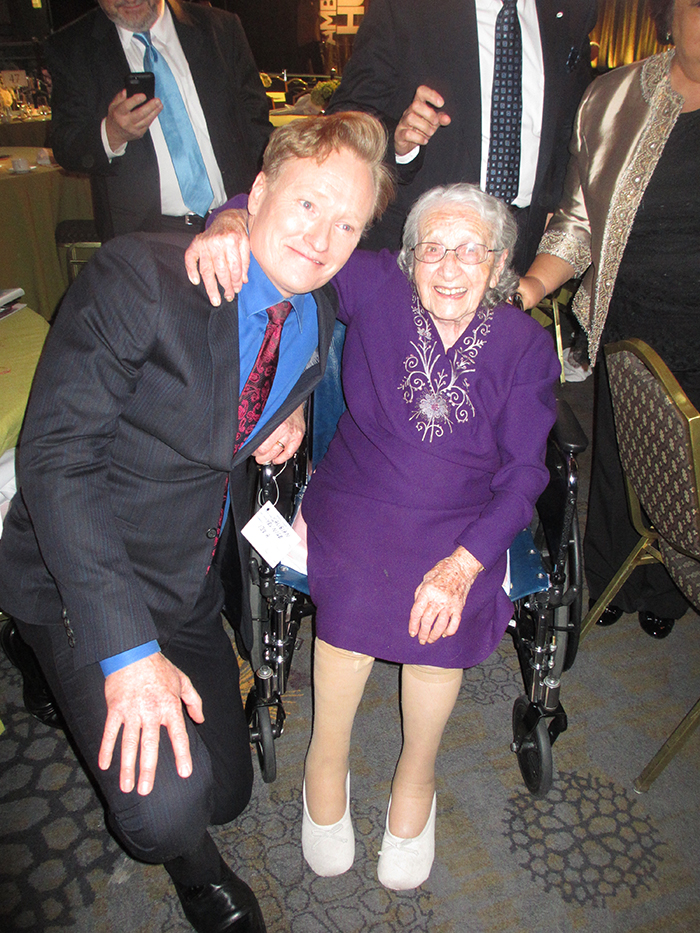
YevnigSalibian-ConanO'brianGrandma was unfortunately unable to meet the president, who was whisked in and out for a brief portion of the evening to speak and accept his award…but alas even the likes of Samuel Jackson were not offered that opportunity and had to take pictures of Obama with iphnes from afar. But at least we had met Kim. =)


Seated next to Kim, I was able to speak with her as we ate dinner. We spoke of her heritage, her trip to Haiti, American materialism, motherhood and fame, the story of Grandma’s dress, the plight of Armenia and the work my parents do there. She said she has not been to Armenia, but is excited to visit one day.


Before the evening concluded, Grandma gave Kim her personal copy of God’s Promises for your Every Need, a book of hundreds of Bible verses organized by subject. I told Kim that I had mentioned to Grandma that she was getting married soon, and that Grandma was a Pastor’s wife and loved God and the Bible and wanted to give Kim the book for her wedding. I told Kim I had placed the bookmark in the section on marriage. Kim seemed very touched. Grandma then told Kim “I want to see you in heaven.”


As we were leaving, we were stopped and told that Conan O’Brien (who had made us all laugh on stage earlier) wanted a picture with Grandma to send to his Armenian assistant. They spoke briefly, she tousled Conan’s hair and made HIM laugh and witnessed to him about the Lord. I explained she was a pastor’s wife and he said “SHE should have made one of the speeches.”


Grandma held up well during the long evening, enamored and fueled by the magical world she had briefly stepped into. Even on the way out, we were stopped several times by those wanting to speak and take pictures with Grandma. The VIP treatment continued as the valet rushed to get our vehicle, ahead of all the others waiting.


All in all it was a lovely evening, thanks to our gracious Shoah hosts, Derik and Maggie from Ararat Home, Grandma for taking me as her date, and my dear sister Searan Kiledjian, for insisting I go in her place.


Oh, and one more resemblance between Cinderalla’s story and Grandma’s that I forgot to mention: they were both wearing slippers to the ball…although Grandma took both of hers back home.


Genocide Survivor Yevnige Salibian Honored By Steven Spielberg and Shoah at 20th Anniversary Gala

Thursday, May 8, 2014

Pope Francis to Catholicos Karekin II: Blood of Martyrs is Seed of Unity

VATICAN CITY — Pope Francis received His Holiness Karekin II, Supreme Patriarch and Catholicos of All Armenians, on Thursday at the Vatican. The Catholicos is in Rome on a three-day visit that concludes on May 9. In remarks prepared for the occasion, Pope Francis recalled Pope St. John Paul II’s 2001 visit to Armenia, and the many other visits the Catholicos has made to Rome and to the Popes in the Vatican, especially his 2008 visit to Pope Benedict XVI and his participation in the inauguration of Pope Francis’ own pontificate.


The Holy Father went on to recall Catholicos Karekin II’s participation in the Jubilee year commemoration of the Witnesses to the Faith of the 20th century.


“In truth,” said Pope Francis, “the number of disciples who shed their blood for Christ in the tragic events of the last century is certainly superior to that of the martyrs of the first centuries, and in this martyrology, the children of the Armenian nation have a place of honor.” Pope Francis went on to say, “The mystery of the Cross, Holiness, so dear to the memory of your people, represented in the splendid stone crosses that adorn every corner of your land, has been lived by countless of your children as a direct participation in the chalice of the Passion.” “Their testimony,” he continued, “at once high and tragic, must not be forgotten.”


Pope Francis went on to say that the suffering endured by Christians in recent decades has brought a unique and inestimable contribution also to the cause of Christian unity.


“As in the ancient Church, the blood of the martyrs became the seed of new Christians,” said Pope Francis, “so in our day the blood of many Christians has become the seed of unity.” The Pope continued, saying, “The ecumenism of suffering and the ecumenism of martyrdom, the ecumenism of blood is a powerful call to journey along the road of reconciliation among the Churches, with decision and with trusting abandonment to the action of the Spirit.” Pope Francis said, “We feel the duty to go down this road of fraternity, also because of the debt of gratitude we owe to the suffering of our brothers, which has become salvific because it has been united to the passion of Christ.”


Pope Francis to Catholicos Karekin II: Blood of Martyrs is Seed of Unity

Stepanakert: No Return to Former Borders

STEPANAKERT — “We consider it necessary to note that the position of the Nagorno Karabakh Republic on the prospects of settlement of the Azerbaijani-Karabakh conflict remains unchanged,” the Ministry of Foreign Affairs of the Nagorno Karabakh Republic said in a statement, responding to James Warlick, Washington’s chief Karabakh negotiator, who had outlined United States official position on settlement of Karabakh conflict.


“Any return to the past is out of question. The fate of Nagorno Karabakh has been determined by its people through a free and legitimate expression of will in the 1991 referendum on independence. NKR independence and security are absolute values that are not subject to any bargaining,” the statement reads.


“We believe that the joint efforts of the OSCE Minsk Group should focus on the development of such settlement mechanisms that stem from current realities and provide conditions for the peaceful coexistence of two independent states – the Nagorno Karabakh Republic and Azerbaijan – emerged as a result of the collapse of the USSR and the war unleashed by Azerbaijan,” the Foreign Ministry said.


Meanwhile, Nagorno Karabakh Republic president’s spokesman Davit Babayan in an interview with Armenpress announced that there exists only one viewpoint in Stepanakert – there can be no return to previous borders.


“We follow the NKR Constitution which emphasizes that there are no liberated or some other type of lands. There is only land – Republic of Artsakh,” says Babayan.


Stepanakert: No Return to Former Borders

Artsakh Recognition Passes California Assembly

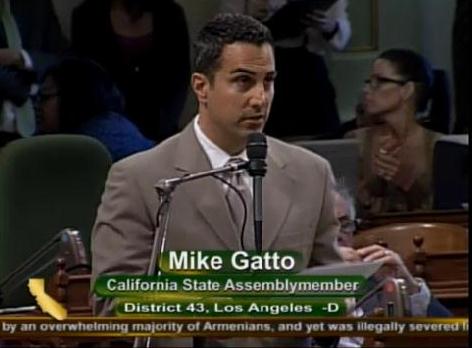
Assemblymember Mike Gatto addressing the California State Assembly during AJR 32 Assembly Floor debate. Assemblymember Mike Gatto addressing the California State Assembly during AJR 32 Assembly Floor debate.


SACRAMENTO—The California State Assembly, on Thursday, May 8th, 2014, passed Assembly Joint Resolution 32, with a landslide victory of 70 ayes and only 1 no vote, introduced by Assemblymember Mike Gatto (D-Los Angeles), making California the most populous governmental entity to recognize Nagorno-Karabakh and calls for the United States to recognize the Nagorno-Karabakh Republic as a sovereign state, invoking strong language from the United States’ own history regarding the rights of the people to “self-determination and democratic independence.”


“It has been my privilege to work with the leaders of the local Armenian American community and their outstanding representatives on this Resolution and I am proud to announce that it has passed on the Assembly Floor,” said Assemblymember Gatto.


“As Californians, we have always been proud of our State’s record reinforcing the principles of democracy and the right to self-determination. Yet, until today, California was lagging behind other States who have passed similar Resolutions to AJR 32,” stated Sevak Khatchadorian, Chair of the Armenian Council of America. “With the passage of AJR 32, California stands by the people of Artsakh, who advocate democracy based on and ideals of freedom and the pursuit of happiness.”


Along with the primary author, Assemblymember Gatto, AJR 32 was co-authored by Assemblymembers; Katcho Achadjian (R-San Luis Obispo), Raul Bocanegra (D-Pacoima), Cheryl R. Brown (D-San Bernardino), Ian Calderon (D-Whittier) , Matt Dababneh (D-Encino), Brian Nestande (R-Palm Desert), Kristin Olsen (R-Modesto), and Jim Patterson (R-Fresno).


California has become the fifth U.S. state – after Rhode Island, Massachusetts, Maine and Louisiana – to recognize the independence of Nagorno-Karabakh.


A full text of AJR 32 can be found here.


The Armenian Council of America is a grassroots organization dedicated to working with all political leaders, offering Armenian related news, analysis and resources for policymakers, media, students and activists, advocating issues important to Armenian Americans. The Armenian Council of America aims to strengthen U.S. – Armenia and U.S. – Nagorno Karabakh ties, the development of programs promoting sustainable economic growth and good governance in Armenia, while promoting the values and responsibilities of global citizenship.


Artsakh Recognition Passes California Assembly

Wednesday, May 7, 2014

James Warlick Presents Official U.S. Government Policy on Karabakh Settlement

WASHINGTON, DC — Armenia and Azerbaijan agree on the basic elements of a Nagorno-Karabakh settlement and must now take a final “bold step” to hammer out a historic peace deal, the United States said on Wednesday.


In what he called a “statement of official U.S. government policy,” James Warlick, Washington’s chief Karabakh negotiator, urged the Armenian and Azerbaijani presidents to meet again soon and iron out their differences on a framework peace accord drafted by the American, Russian and French mediators.


“Peace is within reach,” Warlick said in a speech at the Washington-based Carnegie Endowment for International Peace. “The sides have come to a point where their positions on the way forward are not that far apart. They have almost reached agreement on several occasions – most recently in 2011.”


“The challenge is to find a way to help the sides take that last, bold step forward to bridge their remaining differences,” added the U.S. co-chair of the Minsk Group.


Following is the full text of Warlick’s statement:


Carnegie Endowment for International Peace, Wednesday, May 7, 9:00am


Distinguished guests, ladies and gentlemen:


Thank you for joining me this morning. I recognize a number of you who have served as counsel or sounding-board for me over the past eight months and I want to extend a special thanks to you.


Let me start by saying that I do not want to revisit the history of the conflict. Our goal should be to find a pragmatic way forward to bring about a lasting settlement.


Although I speak to you today as the U.S. co-chairman of the OSCE Minsk Group, I do not speak for the co-chairs. My message to you is a statement of official U.S. government policy that guides our engagement as we help the parties find peace.


And peace is within reach. The sides have come to a point where their positions on the way forward are not that far apart. They have almost reached agreement on several occasions – most recently in 2011. And when they inevitably returned to the negotiating table after each failed round, the building blocks of the next “big idea” were similar to the last time.


There is a body of principles, understandings, and documents already on the table that lay out a deal, and no one has suggested we abandon them. The challenge is to find a way to help the sides take that last, bold step forward to bridge their remaining differences and deliver the peace and stability that their populations deserve.


For two decades, however, peace has been elusive. All parties distrust each other and a generation of young people has grown up in Armenia and Azerbaijan with no first-hand experience of each other. As many have noted, older generations remember a time when Armenians and Azerbaijanis lived side-by-side and differences did not need to be resolved through the barrel of a gun.


As Churchill once reminded us, “you negotiate peace with your enemies, not with your friends.” The key to any successful negotiation is for all parties to conclude that they have won something, and in the case of the Armenians and Azerbaijanis there is no question that a deal will unlock a new era of prosperity across the region. The benefits of peace far outweigh the costs of continued stalemate, and avoid the catastrophic consequences of renewed hostilities.


Armenia would immediately benefit from open borders, greater security, and new opportunities to trade, travel, and engage with all its neighbors.


Azerbaijan would eliminate a key impediment to its growth as a player on the world stage, regional trade hub, and strong security partner, while giving hundreds of thousands of refugees and internally displaced persons a prospect for reconciliation and return.


The thousands of people living in Nagorno-Karabakh would be freed from the prison of isolation and dependence.


A peace agreement, properly designed and implemented, would also eliminate the tragic, steady stream of casualties – both military and civilian – along the border and the Line of Contact. Numbers are hard to pin down, but there have already been at least a dozen killed and even more injured on the front lines this year so far. This is unacceptable.


No less significant is the huge financial burden that military readiness and a growing arms race imposes on national budgets – a peace dividend that, used more productively, could itself be a game changer for both Armenia and Azerbaijan.


Next week will mark 20 years since a ceasefire agreement was signed. While we can take some pride in having avoided a return to outright war, we must also agree that the current state of affairs is unacceptable, and unsustainable.


Perpetual negotiations, periodic outbreaks of violence, the isolation of Armenia and the people living in Nagorno-Karabakh, frustration in Azerbaijan and anger among its populations of IDPs – this is not a recipe for peace or stability and it is certainly not the path to prosperity.


The people of the region deserve better.


—-


I began this job last September with a trip to the region, with visits to Baku and Yerevan to meet the two presidents and their foreign ministers. I also made a side trip to Nagorno-Karabakh to join Ambassador Andrzej Kasprzyk’s team for an OSCE monitoring mission along the Line of Contact on the road between Agdam and Gindarkh.


I joined the team on the west side of the Line of Contact, and got my first glimpse of the front lines. I saw the bleak reality faced by young soldiers on both sides of this Line, who live and work behind trenches and berms, with nothing but barbed wire and land mines keeping them apart.


The sides live under threat from sniper fire and landmines. They are concerned for the lives of their civilian populations and their access to farmland, cemeteries, and buildings that happen to fall “too close” to the Line of Contact or the international border between Armenia and Azerbaijan.


OSCE monitors have been working for two decades to keep an eye on this fragile peace, but have neither the mandate nor the resources to put a stop to the frequent casualties, or even to identify responsibility.


The sides themselves report thousands of ceasefire violations every year, but have been unable to reach agreement on any means of reducing that tally.


I have also traveled throughout Nagorno-Karabakh itself, where I have met with the de facto authorities to hear their views. I plan to do so again next week with the other co-chairs. There is no question that any enduring peace agreement must reflect the views of all affected parties if it is to succeed.


In the capitals, I have heard a more reassuring message. Both presidents want to make progress. Both agree that the series of documents negotiated over the past several years contains the outlines of a deal.


The co-chairs hosted the presidents in Vienna last November. This was their first meeting since January 2012 – and the first time since 2009 for them to meet one-on-one. We were encouraged by their conversation, and by their stated commitment to find a way forward. Since that time, we have met on ten separate occasions with one or both foreign ministers to keep the discussion alive.


It is clear, however, that only the presidents have the ability to conclude a deal with such transformative consequences for their countries. It is the presidents who must take the bold steps needed to make peace. The United States has pressed both leaders to meet again soon and take advantage of this window of opportunity when peace is possible.


—-


When I made that first trip to Baku and Yerevan last fall, I carried with me President Obama’s endorsement and reaffirmation of the U.S. commitment to working for peace as a Minsk Group co-chair and a close partner with both countries. The outlines of a compromise were already well established by that point, and my message was that the time had come for a renewed effort to bring peace to the region.


Let me walk you through the key elements of that “well-established” compromise, all of which have been in the public domain since appearing in joint statements by Presidents Obama, Medvedev, and Sarkozy in L’Aquilain 2009 and Muskoka in 2010. These principles and elements form the basis of U.S. policy toward the Minsk Group and the Nagorno-Karabakh conflict.


At the heart of a deal are the UN Charter and relevant documents and the core principles of the Helsinki Final Act. In particular, we focus on those principles and commitments that pertain to the non-use or threat of force, territorial integrity, and equal rights and self-determination of peoples.


Building on that foundation, there are six elements that will have to be part of any peace agreement if it is to endure. While the sequencing and details of these elements remains the subject of negotiations, they must be seen as an integrated whole. Any attempt to select some elements over others will make it impossible to achieve a balanced solution.


In no particular order, these elements are:


First, in light of Nagorno-Karabakh’s complex history, the sides should commit to determining its final legal status through a mutually agreed and legally binding expression of will in the future. This is not optional. Interim status will be temporary.


Second, the area within the boundaries of the former Nagorno-Karabakh Autonomous Region that is not controlled by Baku should be granted an interim status that, at a minimum, provides guarantees for security and self-governance.


Third, the occupied territories surrounding Nagorno-Karabakh should be returned to Azerbaijani control. There can be no settlement without respect for Azerbaijan’s sovereignty, and the recognition that its sovereignty over these territories must be restored.


Fourth, there should be a corridor linking Armenia to Nagorno-Karabakh. It must be wide enough to provide secure passage, but it cannot encompass the whole of Lachin district.


Fifth, an enduring settlement will have to recognize the right of all IDPs and refugees to return to their former places of residence.


Sixth and finally, a settlement must include international security guarantees that would include a peacekeeping operation. There is no scenario in which peace can be assured without a well-designed peacekeeping operation that enjoys the confidence of all sides.


—-


The time has come for the sides to commit themselves to peace negotiations, building on the foundation of work done so far. It is not realistic to conclude that occasional meetings are sufficient by themselves to bring about a lasting peace.


When such negotiations commence, the parties should not only reconfirm their commitment to the ceasefire but also undertake much-needed and long-sought security confidence-building measures.


Once we get into such peace negotiations, there is a much broader range of practical issues that we can put on the table to benefit all sides. There are economic and commercial incentives to develop; energy, transportation, and communications links to rebuild; and travel and people-to-people programs that can begin to counter the dangerously one-sided narratives that currently prevail.


The co-chairs of the Minsk Group share a common interest in helping the sides reach a peaceful resolution. We intend to continue working through the Minsk Group as the primary channel for resolving this conflict. Together with France, the United States and Russia share a common commitment to peace and security in Nagorno-Karabakh. The United States stands ready to help in any way we can. I would also call on the diaspora communities in the United States and around the world to speak out for peace and to help bring an end to this conflict.


Of course, it is up to the governments of Armenia and Azerbaijan to take the first step. They should consider measures, even unilateral ones, that will demonstrate their stated commitment to making progress, reducing tensions, and improving the atmosphere for negotiations. They should reduce the hostile rhetoric, and prepare their populations for peace, not war.


Track II efforts to build people-to-people contacts between Azerbaijanis and Armenians are no less integral to a lasting settlement. Programs of this kind can help citizens of both countries prepare for peace and find reconciliation with the pain of the past. We expect the sides to support organizations and individuals which are committed to Track II and people-to-people programs.


I hope that you will work with us to make the case for a lasting peace. The co-chairs have the mandate to facilitate negotiations, but we should all be supporting engaged citizens, secular and religious leaders, NGOs, media outlets, and others working toward these goals. A lasting peace must be built not on a piece of paper, but on the trust, confidence, and participation of the people of both countries.


Let’s work together to build the demand for peace. Let’s demand the benefits that a peaceful settlement will bring to people across the region.


Thank you.


James Warlick Presents Official U.S. Government Policy on Karabakh Settlement

'Genocide' Does Not Describe the Armenian Experience

In an op-ed piece published in the Forbes, Jano Boghossian, a descendant of survivors of the Armenian Genocide, says that the term “genocide” is inadequate in describing the attempted extermination of a historic people, and the trauma inherited in a victim group, continuously fueled by denial. The full article is presented below:


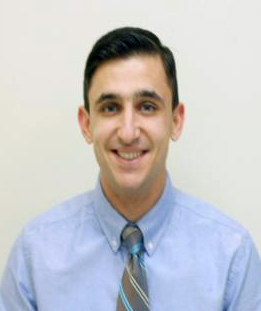
JanoBoghossianBy Jano Boghossian


April 2014 marked the 99th anniversary of the beginning of one of the greatest crimes against humanity. In the 20th century alone, more than 100 million perished through war and genocide. What makes the lives of the 1.5 million Armenians any more significant?


The Armenian experience is as common as it is unique. Armenian history is a part of human history, thus the Armenian experience must be remembered as a significant part of the human experience. To fully comprehend the historiography of the Armenian experience requires the examination of the events leading up to 1915, not in a vacuum, but, in the context of world history. This article is meant to analyze the legacies that transcend past the survivors into our collective consciousness.


The rise of nationalism in the 19th century dictated much of the reforms brought upon not only Europe, but also the Ottoman Empire . A concerted effort by minorities seeking independence expedited the dissolution of the once-mighty empire. The eventual loss of territory in the Balkans and Caucasus weakened the empire, and its demise was imminent. As Armenians looked for aid in their liberation struggle, Abdul-Hamid II could not tolerate further irredentism and lived up to his name of the “Red Sultan” by massacring 300,000 Armenians from 1894-96. In 1909, a year after the Young Turks led a progressive revolution promising reform and liberalism, government forces again murdered 30,000 Armenians in Adana. Once the Young Turks seized power, their xenophobic policies became apparent and they began dehumanizing minorities. On the eve of world war, chaos loomed out of the darkness.


The Armenian experience parallels the struggles of oppressed minorities and second-class citizens in larger traditional societies. For generations, the Turkish ruling class maintained social equilibrium as long as their authority went unquestioned. As societal infrastructure broke down, minorities sought equality, and the ruling class looked for a scapegoat. Friends and neighbors living peacefully for generations suddenly turned against one another. The idea of a nation-state governed by one party eventually bred xenophobic nationalism. Officials began recognizing their previous crimes as having gone unpunished and planned further atrocities. The Armenians had the Hamidian and Adana massacres, the Jews had years of anti-semitic laws and Kristalnakht, and the Tutsis in Rwanda began arming civilians with machetes. The perpetrators preferred a strong homogenous nation-state to a multiethnic empire; those who did not belong and questioned authority faced fatal consequences.


The cover of major international conflicts provided the opportunity for the likes of the Young Turks, Nazis, the Khmer Rouge, and others to carry out their plans without repercussion, knowing no one would intervene. In this sense, the Armenian experience serves as a prototype for modern genocides, but that term cannot truly describe the chaos of 1915.


The United Nations Genocide Convention lists five criteria that constitute genocide. What is compelling is that the Armenian people were subjected to each and every one of the five. But what these criteria fail to consider are the after-effects of Genocide. Holocaust survivor Elie Weisel describes the 8 stages of genocide: classification, symbolization, dehumanization, organization, polarization, preparation, extermination, and denial. Denial is the continuation of genocide, but not even “genocide” can fully encompass such a catastrophe. Marc Nichanian, a French-Armenian author, claims that attempts to objectify “genocide,” that is, lending meaning to the indefinable, trivialize the inherent chaos that accompanies the event.


“Genocide” cannot encompass the totality of the pain caused by the Young Turk regime. The term is inadequate in describing the attempted extermination of a historic people, and the trauma inherited in a victim group, continuously fueled by denial. “Genocide” cannot convey the forced exile, the loss of a 3,000 year old homeland, the destruction of a powerful intelligentsia, and attempted eradication of an extensively rich culture. “Genocide” is inadequate because it cannot do justice to the lands, property, and wealth transferred from the Armenians to modern-day Turkey. “Genocide” does not encompass the attempts by a denialist government to rewrite history by bestowing lies and falsifications of human history upon its younger generations. “Genocide” does not portray the difficult path to reconciliation, reparations, and redemption.


This is not a matter of semantics, nor is it about politics. The unbridled chaos of 1915 marked and traumatized all subsequent generations of Armenians both in the small remaining homeland, and the far-reaching Diaspora. Victim groups have no need for a justification of memory, but they do need justice.


Mr. Boghossian is a descendant of survivors of the Armenian genocide and a graduate of the University of California, Los Angeles.


'Genocide' Does Not Describe the Armenian Experience