Tuesday, May 13, 2014

Recognizing Armenian Genocide is a Moral Imperative for Jews: Knesset Speaker

Armradio.am — As Jews, we must recognize the suffering of the Armenian people, even if we do not blame anyone, Knesset Speaker Yuli Edelstein said Tuesday at a plenum discussion of the Armenian genocide, the Jerusalem Post reports.


In response to a motion to the agenda by MK Zehava Gal-On (Meretz), Edelstein said “this discussion does not blame any modern country, rather it shows that we identify with the victims of the massacre and its terrible outcome.


“We are not placing blame; we are acting like Jews and being faithful to the truth and the suffering of another people,” Edelstein added. “We cannot deny history and hold back human values out of diplomatic or political caution.”


Gal-On called for the government to recognize the Armenian Genocide before its 100th anniversary next year.


“The government should sacrifice the recognition in the name of temporary interests,” she said. “Every time there’s a different diplomatic situation. When we’re for relations with Turkey, we don’t recognize the genocide and then there’s the Marmara [Turkish flotilla ship to Gaza] and we change our mind.”


The Meretz leader pointed out that many MKs are children of Holocaust survivors.


“As a nation that experienced the Holocaust, we cannot continue to ignore the Armenian genocide because of irrelevant considerations,” she stated.


According to MK Reuven Rivlin (Likud Beytenu), the Jewish People were “next in line” after the Armenians to be killed.


“Whoever thought of the Final Solution got the impression that, when the day comes, the world will be silent, like it was about the Armenians. It is hard for me to forgive other nations for ignoring our tragedy and we cannot ignore another nation’s tragedy. That is our moral obligation as people and Jews,” Rivlin said.


Rivlin said that a recent expression of regret from a Turkish official is connected to the fact that many countries, including Israel, refuse to ignore the genocide.


Tourism Minister Uzi Landau responded to the motion in Foreign Minister Avigdor Liberman’s place, saying that as Jews and Israelis, there is a moral obligation to recognize human tragedies, including the Armenian genocide.


“It is a good thing that the Knesset marks these tragedies. The State of Israel never denied what happened,” Landau stated.


However, the Tourism Minister said that in recent years the topic became a political one between Turkey and Armenia and each side is trying to prove it is right.


“We hope these two countries will authorize the agreement they signed several years ago and will continue to have an open, deep dialogue that will allow them to heal from the wounds that remained open for decades,” Landau said.


When the discussion ended, the motion was moved to the Knesset Foreign Affairs and Defense Committee, as opposed to the Knesset Education Committee as Gal-On proposed.


Gal-On accused Liberman of sending MK Shimon Ohayon (Likud Beytenu) to make sure the motion was moved to the classified committee in order to “bury” it.


Recognizing Armenian Genocide is a Moral Imperative for Jews: Knesset Speaker
Rep. Schiff Presses Erdogan, Gul and other top Turkish Officials on the Armenian Genocide, the Blockade of Armenia, and the Plight of the People of Kessab at Meeting in Ankara

Schiff: “Fact That Some Armenians Escaped Annihilation Makes It No Less a Genocide”


WASHINGTON, DC – As part of a Congressional Delegation to the Middle East and Asia focused on terrorism, homeland security and the war in Syria, Representative Adam Schiff (D-CA) had separate meetings with Turkish Prime Minister Tayyip Erdogan, President Abdullah Gul and other Turkish high government officials.


In his meeting with the Prime Minister, Schiff challenged the notion expressed by Erdogan in a recent interview that because there are Armenian survivors still living in Turkey, there could have been no genocide. This is the equivalent, Schiff argued, of saying that because some Jews in Europe escaped death, there was no Holocaust. Schiff also questioned whether it was possible to have the open discourse in Turkey about the events of 1915-1923 that Erdogan called for in his statement of April 23rd, if Turkish professors, historians, journalists and ordinary citizens still faced demotion, intimidation, potential prosecution or violence for expressing the conviction that the Armenian Genocide is a historic fact.


In his meeting with President Gul, Schiff said  that he wanted to speak for the many tens of thousands of his constituents of Armenian descent who may never get the chance to address the President directly.


“You will not find one of my 80,000 Armenian constituents untouched by the Genocide,” he said. “Each of them has lost a parent or grandparent, their cousins, brothers or sisters, or their entire family. Their pain is real, their wounds are open, this is no distant relic of the past. To say, as you and the Prime Minister have, that yes, Armenians suffered but so too did Turks during World War I, is akin to saying that the Germans also suffered during World War II. It is true that many German civilians died, many noncombatants, but that does not negate the Holocaust any more than the fact that many Turks died could negate the Genocide. To propose, as you have, that a historic commission be established to ascertain the facts of the Genocide is not unlike suggesting that a commission needs to be established to determine whether the Holocaust took place.”


Schiff also raised the issue of Kessab, and his concern over the forced evacuation of the historic Armenian community there and  the wellbeing of those residents who are now refugees in Turkey. He also urged Turkey to decouple the blockade of Armenia from resolution of the issues concerning Nagorno Karabagh, so that we can bring about an end to Armenia’s economic isolation and a normalization of trade relations.


Rep. Schiff Presses Erdogan, Gul and other top Turkish Officials on the Armenian Genocide, the Blockade of Armenia, and the Plight of the People of Kessab at Meeting in Ankara

Hollande: Turkey Must Acknowledge the Armenian Genocide

YEREVAN — Turkey must recognize the Armenian Genocide, French President Francois Hollande said today in Yerevan in comments on a statement by Turkish prime minister Recep Tayyip Erdogan on April 23 in which he offered condolences to the grandchildren of Armenians killed in World War One by Ottoman soldiers.


“I always try to find something positive in such signs … But it is vital that the annihilation of Armenians were recognized as genocide,” said Hollande during a joint press conference with Armenian President Serzh Sargsyan.


Francois Hollande reaffirmed his willingness to participate next April in the commemorative events to take place in Armenia on the 100th anniversary of the Armenian Genocide.


“I will arrive in Yerevan to attend the 100th anniversary of the genocide. It will mean France’s participation at the highest level to remember this horrific genocide,” he said.


This is a step toward a nation that went through great pain. This is a message to the world so as such terrible slaughter should never be committed again. France’s responsibility is that such things do not happen in the world, the French leader said.


Speaking about the Karabakh issue, President Hollande said: “As a Minsk Group co-chairing country, France is ready to do its best to find a solution to the issue. Although there is a ceasefire agreement, it’s not enough. A thorough solution is needed,” he said.


Francois Hollande added that France is ready to host a meeting of the Presidents of Armenia and Azerbaijan to help find confidence-building measures. He said that during his visit to Baku he had expressed his willingness to do everything in his power for the peaceful resolution of the conflict.


“It was the 20the anniversary of the ceasefire yesterday, but that’s not a solution, we must find a new solution,” Hollande said.


Hollande: Turkey Must Acknowledge the Armenian Genocide

Monday, May 12, 2014

French President Francois Holland Visits Armenia

Hollande-Tsitsernakaberd-5YEREVAN — French President Francois Holland arrived in the Armenian capital on the second leg of his tour of the three South Caucasus states which he began in Baku on Sunday. He and his Armenian counterpart, Serzh Sarkisian, opened a French-Armenian business forum immediately after a welcoming ceremony held at the Zvartnots international airport.


Hollande stated that the European Union should upgrade its relationship with Armenia to political “association” despite Yerevan’s plans to join the Russian-led Customs Union.


“We are not forcing Armenia to make a choice that runs counter to Armenia’s interests. I spoke with Serzh Sarkisian about that during his visit to France [last autumn,]” Hollande told the forum attended by several dozen French businesspeople.


“We need to devise a Europe-Armenia association that would not constrain you with regard to the Customs Union plans that you have with Russia,” he said. The EU and Armenia can work out a model for such association, he added.


Hollande’s remarks suggest that the Armenian government might now count on French support for the idea. Sarkisian insisted on it in a speech at an EU summit in Dublin held late last month. He said his country must not be made to “pay a price” for moving even closer to Russia.


France has traditionally been a key EU backer of Armenia, owing, in large measure, to the existence of a large and influential French-Armenian community. Hollande underscored the community’s clout later on Monday when he attended with Sarkisian a concert of French-Armenian singer Charles Aznavour. The two presidents will inaugurate on Tuesday a small park in Yerevan renamed after Missak Manouchian, a prominent member of the French Resistance movement executed by the Nazis in 1944.


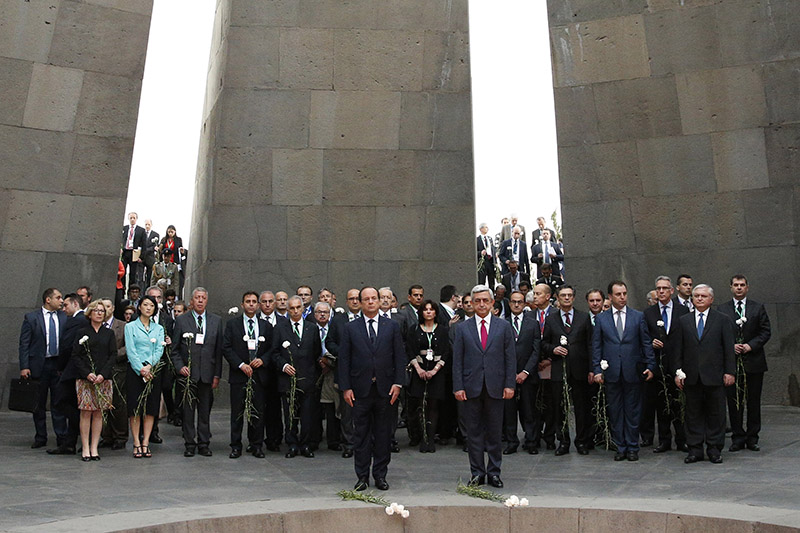
Presidents Sarkisian and t Hollande visited Tsitsernakaberd Memorial Complex, laid a wreath at the memorial to the victims of the Armenian Genocide and placed flowers at the eternal fire .


The French President also planted a fir tree at the Memory Park of the Memorial Complex.


French President Francois Holland Visits Armenia

NKR Issues Statement on 20th Anniversary of Ceasefire Agreement

The Ministry of Foreign Affairs of the Nagorno-Karabakh Repiblic (NKR) has issued a statement on the 20th anniversary of the ceasefire agreement.


The statement reads:


Today marks 20 years of the ceasefire agreement in the Azerbaijani -Karabakh conflict zone signed by the Nagorno Karabakh Republic, the Republic of Azerbaijan and the Republic of Armenia with the mediation of the Russian Federation. The agreement, which became the only real achievement in the Azerbaijani-Karabakh conflict settlement process put an end to large-scale hostilities and thus laid the foundations for peace talks as well as created conditions for the activities of mediators to find a just and lasting solution to the conflict.


At the same time, we are compelled to state that, despite all the efforts and consistent work of the mediators on bridging the positions of the sides and finding a mutually acceptable solution, there is no progress in transforming the ceasefire into a final and lasting peace.

Periodically on the Line of Contact of the armed forces of the Nagorno-Karabakh Republic and Azerbaijan incidents occur fraught with serious escalation of tensions and undermining the efforts of the mediators to find a peaceful settlement. Since the beginning of 2014 more than seven thousand cases of ceasefire violations from Azerbaijani side have been registered. 20 years after the signing of the agreement that ended the military phase of the conflict, military and civilian losses still occur. We are profoundly convinced that such actions are not caused by military necessity and are in fact deliberate acts of murder and unjustified terror.


Constant provocations on the Line of Contact and the ongoing threats of a new war by Azerbaijan only complicate the settlement process and distance the prospect of a final settlement of the Azerbaijani-Karabakh conflict. We are deeply convinced that only the complete elimination of the possibility of resumption of hostilities can help to find a way out of the current situation in the conflict settlement process and provide a solid foundation for a lasting and final peace.


Recognizing the importance of strengthening confidence and security between the Nagorno-Karabakh Republic and Azerbaijan for the consolidation of the ceasefire regime and the exclusion of a new military escalation, the Karabakh side repeatedly came up with initiatives aimed at reducing tensions and promoting stability and predictability along the Line of Contact between the armed forces of the NKR and Azerbaijan.


In particular, in 2001 the leadership of the Nagorno Karabakh Republic through the Co-Chairs of the OSCE Minsk Group transferred to the Azerbaijani side a package of confidence building measures, including the cooperation of the sides of the conflict in all spheres, along with the sphere of military security. Among the proposed measures was the confirmation by the sides at the highest level of their commitment to the preservation of the current ceasefire regime and settlement of the conflict only by peaceful means under the auspices of the OSCE, as well as establishment of direct communication lines between sides and/or their operational headquarters and at the local level.


In 2004, the Nagorno Karabakh Republic proposed to establish a permanent monitoring of the ceasefire regime by means of expanding the staff of Office of the Personal Representative of the OSCE Chairman.


In 2006, the Nagorno-Karabakh Republic proposed that all three sides mutually reaffirmed their commitment to strengthening the ceasefire regime enshrined in the agreement, which was reached under the auspices of the OSCE, by the Nagorno Karabakh Republic, the Republic of Armenia and the Republic of Azerbaijan and entered into force on 6 February 1995.


In 2012, the Nagorno-Karabakh Republic, as an initial step, proposed to withdraw snipers from the Line of Contact and to refrain from any provocative actions during religious holidays (such as Easter and Novruz).


Unfortunately, none of the proposals of the Nagorno Karabakh Republic, despite mediators’ support of them and the calls of the international community, was accepted by the Azerbaijani side.


Nevertheless, the Nagorno-Karabakh Republic, being committed to exclusively peaceful settlement of the conflict between Azerbaijan and Nagorno Karabakh through negotiations, as well as strengthening the stability and security in the South Caucasus, renews its proposals to consider a package of confidence and security building measures.


The 20th anniversary of the entry into force of the ceasefire agreement in the zone of the Azerbaijani-Karabakh conflict provides a good opportunity to reaffirm commitment to exclusively peaceful settlement and the renewal of proposals and initiatives designed to ensure the irreversibility of the peace process and achieving a final and lasting peace.


NKR Issues Statement on 20th Anniversary of Ceasefire Agreement

OSCE Minsk Group Co-Chairs Statement on the 20th Anniversary of the Ceasefire Agreement

The United States, Russian and French co-chairs of the OSCE Minsk Group, James Warlick, Igor Popov and Jacques Faure, have issued a statement on the occasion of the 20th anniversary of the 1994 ceasefire agreement, questioning the conflicting parties’ declared commitment to peace and urging to build on a “promising renewal of dialogue”. The statement reads:


“On the twentieth anniversary of the 1994 ceasefire agreement, the OSCE Minsk Group Co-Chairs invite the people of the region to reflect upon the legacy of the past two decades.


That agreement brought an end to outright war, halted the tragic violence of previous years, and laid the groundwork for negotiations that offered the sides a path to peace. Thanks to the resulting truce a new generation of Armenians and Azerbaijanis grew up without experiencing the horrors of war. The sides should do everything possible to protect future generations from such experience.


The ceasefire agreement did not, however, resolve the underlying conflict. It left the territories surrounding Nagorno-Karabakh occupied and failed to provide a path forward on status for Nagorno-Karabakh. The absence of a final settlement has resulted in the ongoing displacement of hundreds of thousands of people, the perpetual threat of escalating violence along the international border and the Line of Contact, and a misconception in some quarters that the status quo can be sustained indefinitely.


The sides have shown little willingness to take advantage of the opportunities presented by the co-chairs countries or make the political decisions necessary for progress in this peace process.


We share a common position on this conflict, and remain firmly committed to helping the sides reach a peaceful settlement as soon as possible based on the core principles of the UN Charter and the Helsinki Final Act, particularly those pertaining to the non-use of force, territorial integrity, and equal rights and self-determination of peoples. A settlement will have to include the elements outlined by the Presidents of the co-chair countries in statements from 2009 to 2013, which include the return of the territories surrounding Nagorno-Karabakh, interim status for Nagorno-Karabakh guaranteeing security and self-governance, a corridor linking Armenia to Nagorno-Karabakh, final status of Nagorno-Karabakh to be determined in the future by a legally-binding expression of will, the right of all internally-displaced persons and refugees to return, and international security guarantees, including a peacekeeping operation. In November we saw a promising renewal of dialogue at the highest levels. We call on the sides to enter into constructive, good-faith negotiations resulting in a peace agreement based on these elements in order to bring about a lasting settlement to the conflict.


Such a settlement will not be possible without a basis of trust and understanding between the Armenian and Azerbaijani people. We call on the sides to commit to active people to people programs and security confidence building measures to reinforce the peace process.


Armenians and Azerbaijanis deserve to live in peace and security, and we stand ready to help. The sides must take the necessary steps towards peace. When they do, it will be with the full support of the OSCE and the international community.”


The Russian-brokered agreement signed in May 1994 by the defense chiefs of Armenia, Azerbaijan and Karabakh ended nearly three years of fierce fighting that left the Armenian side in control of almost the whole of Karabakh and Azerbaijani districts surrounding the disputed enclave.


Around 7,000 Armenian soldiers and over 1,260 civilians, the vast majority of them Karabakh residents, died during the war. Azerbaijan publicized early this year an incomplete official list of over 11,500 combat deaths. The late President Heydar Aliyev spoke of some 21,000 Azerbaijani war casualties, including civilians.


The warring sides have suffered hundreds of more casualties since May 1994. Nevertheless, their uneasy truce has largely held despite periodic outbreaks of fighting involving small arms.


OSCE Minsk Group Co-Chairs Statement on the 20th Anniversary of the Ceasefire Agreement

Shushi: Restoring the Crown Jewel of Armenian Civilization

Shushi sits atop Artsakh like a crown. Its peaceful beauty today makes it hard to believe that this Armenian town was where nonstop Azerbaijani attacks were being launched against the civilian population of Stepanakert. It wasn’t the first time Shushi was the center of an attack on Armenians: in 1920, Turkey and Azerbaijan colluded to massacre 20,000 Armenians in the town, continuing the genocidal policies being effected to the west.


In the early 1990s, it was after months of shelling by Grad missiles while Armenian soldiers were away fighting in other regions that those men were able to return, liberate the town, and stop the inhumane attacks on civilians by Azerbaijani forces occupying Shushi. It marked a turning point in the Artsakh War for Independence.


The liberation of Shushi was a feat of deft military strategy: outgunned and outmanned Armenian soldiers were tasked with taking a town on higher ground, a mountaintop, and one of the most difficult maneuvers in war.


Its military significance aside, Shushi has been at the center of Armenian history for centuries. Thus, rebuilding the town, badly damaged during the war, to allow its residents to have relatively normal lives was a top priority for Armenia Fund.


Since Artsakh’s independence, there have been over 30 projects that have been funded entirely by donations made by Armenians throughout the world.


Projects have ranged from renovating streets totally ruined during the war to restoring the library to making improvements to the hospital. A cornerstone Armenia Fund project, recently completed, was bringing 24-hour, clean, safe-to-drink running water to the whole town for the first time in 20 years.


Besides the integral infrastructural improvements, an emphasis has been placed on developing Shushi’s educational facilities: of the over 30 projects, 11 have focused on the educational. Destroyed or badly damaged like most everything else in the town, schools were restored or built anew by Armenia Fund to ensure that Shushi’s children had a place where they could attend classes. Today, of the 700 children attending schools in Shushi, 450 are in the Khachatur Abovyan School reconstructed by Armenia Fund.


And the progress is ongoing. The Yeznik Mozian Vocational School is a new facility where young people can learn a trade, developing practical skills in fields like carpentry, metalwork, construction technology, and machinery operation that are in demand. The only one of its kind in the region, the school is open to students from throughout Artsakh, as well as the rest of Armenia. Upon completion, graduates are able to enter the workforce, generate income, and build and provide for their family.


In a country still feeling the effects of war, some children do not receive the parental supervision they deserve. For that reason, Armenia Fund is constructing the Shushi Boarding Kindergarten – an orphanage where children receive shelter and have access to the town’s educational facilities, as well as the opportunity to attend a vocational school later in life.


Shushi’s reputation as an historical hub for Armenian culture also figures into the work that Armenia Fund does there. Most recently the reconstruction of the Shushi Culture and Education Center has sought to reestablish a base for cultural activity. The center will include arts and crafts areas, a folk music band and dance group, a puppet theater, as well as a modern, HD surround-sound movie theater. Supplemental financing from Artsakh’s government is currently going toward building a modern theater stage, as well.


These ongoing projects complement the established institutions in the town that Armenia Fund helped get back on their feet, particularly the Daniel Ghazaryan Music College and Muratsan Vocational School. In the former, puppet theater and dance rehearsals are already attended by schoolchildren and teenagers from Shushi and nearby towns.


In all, since the end of the Artsakh War, Armenia Fund and the Armenians throughout the world who donated to it, have realized over $11.5 million in infrastructural, educational, and cultural projects in Shushi. The impact on the town’s vitality is as plain as day.


The liberation of Shushi was a great victory. Winning the war and securing Artsakh’s independence was an even greater victory. The greatest victory will be to remember and realize what our soldiers were fighting for and what our people died for – the right to live and prosper in a free Armenian land. The work of Armenia Fund is based on a belief in that right and through their contributions, Armenians everywhere have been a continuing part of making it a reality.


Happy Shushi Liberation Day! Our progress continues.


Shushi: Restoring the Crown Jewel of Armenian Civilization