Tuesday, March 4, 2014

Six Armenians on Forbes World Billionaires List

There are six Armenian in the World’s Billionaires list published by Forbes on March 3. Kirk Kirkorian (328th) is still the world’s richest Armenia with an estimated net worth of $4.5 billion. The other Armenian billionaires are Samvel Karapetyan (345th), Danil Khachaturov (663rd), Eduardo Eurnekian (931st) and Sergei Sarkisov and Nikolai Sarkisov (both ranked1465th).


The ranks of the world’s billionaires continue to scale new heights–and stretch to new corners of the world. The global wealth team found 1,645 billionaires with an aggregate net worth of $6.4 trillion, up from $5.4 trillion a year ago. In total, there are 172 women on the list, more than ever before and up from 138 last year.


Bill Gates is back on top after a four-year hiatus, reclaiming the title of world’s richest person from telecom mogul Carlos Slim Helu of Mexico, who ranked No. 1 for the past four years. Gates, whose fortune rose by $9 billion in the past year, has held the top spot for 15 of the past 20 years. Spanish clothing retailer Amancio Ortega (best known for the Zara fashion chain) retains the No. 3 spot for the second year in a row, extending his lead over Warren Buffett, who is again No. 4. American gambling tycoon Sheldon Adelson, who added $11.5 billion to his pile, makes it back into the top ten for the first time since 2007. Another first: A record net worth of $31 billion was needed to make the top 20, up from $23 billion last year.


Kirk Kirkorian, a hotel magnate is still making money — even at the age of 96. Despite selling $750 million worth of shares of MGM International Resorts in recent years, the Chairman emeritus still owns nearly one-fifth its shares, which have nearly doubled in the past year — helping boost his net worth by $1.2 billion.


Samvel Karapetyan heads the Tashir Group, a real estate firm that owns 27 shopping centers, seven office complexes, and seven hotels.


In late 2013 Danil Khachaturov listed shares in his insurance giant Rosgosstrakh, one of Russia’s highest-volume insurers, on the Moscow Exchange. Khachaturov studied construction and finance at Moscow schools and went to work at privately-held BIN Bank and then at Slavneft, an oil company led at the time by billionaire Mikhail Gutseriev.


Through the years, Eduardo Eurnekian, now 71, has proven he is a flexible businessman and entrepreneur. The son of Armenian immigrants, he first delved into the textiles industry, and then the cable TV business in the 1980s.


Sergei Sarkisov got his start at the Soviet state insurance firm Ingosstrakh. In 1991 he founded his own insurer, RESO-Garantiya where he serves as chairman of the board.


Nikolai Sarkisov, the younger brother of billionaire Sergei Sarkisov, oversees the largest clients at Sergei’s insurance company, RESO-Garantiya. The brothers own 63% of the company, while French insurer AXA owns the remaining 37%.


Six Armenians on Forbes World Billionaires List

Embassy of the Republic of Armenia: Azerbaijani Distortion of the Events in Khojaly

WASHINGTON, DC — Azerbaijani diplomacy and propaganda continues to mislead the international community and Azerbaijani people by falsifying the essence and the history of the Nagorno-Karabakh conflict and the facts about the Khojaly events in particular.


By distorting the Khojaly events, Azerbaijani regime attempts to escape the responsibility for the Armenian massacres in Sumgait (February, 1988), Kirovabad (November, 1988), Baku (January, 1990), Maragha (April 1992) and against its own population in Khojaly. Azerbaijan strives to portray itself as a victim, thus trying to prepare a moral ground both domestically and internationally to unleash another war against Nagorno-Karabakh.


Azerbaijan continues to reject international appeals, including by the European Court of Human Rights, to openly debate about the events in Khojaly. In that regard one can only ask why all who have expressed points of views differing from Azerbaijani official version of the events have been either killed, like journalist Mustafaev, or imprisoned like journalist Fatullayev, or politically persecuted like Ayaz Mutalibov, the first president of Azerbaijan?


In reality Khojaly village was one of the Azerbaijani strongholds in the heart of Nagorno-Karabakh which for many months as Human Rights Watch put it “pounded the capital of Nagorno Karabakh, Stepanakert, and other Armenian towns and villages with shells and grenades. The indiscriminate shelling and sniper shooting killed or maimed hundreds of civilians, destroyed homes, hospitals and other objects that are not legitimate military targets, and generally terrorized the civilian population”.[1] Therefore, suppressing the Azerbaijani fire had become a matter of survival for the people of Nagorno-Karabakh.


As Azerbaijani journalist Eynulla Fatullayev stated “And even several days prior to the attack, the Armenians had been continuously warning the population about the planned operation through loudspeakers and suggesting that the civilians abandon the town and escape from the encirclement through a humanitarian corridor. According to the Khojaly refugees’ own words, they had used this corridor and, indeed, the Armenian soldiers positioned behind the corridor had not opened fire on them”[2].


However, goes on Fatullayev “… part of the Khojaly inhabitants had been fired upon by our own [Azerbaijani troops]… Whether it was done intentionally or not is to be determined by investigators … [They were killed] not by [some] mysterious [shooters], but by provocateurs from the NFA[3] battalions … [The corpses] had been mutilated by our own …”[4].


Ayaz Mutalibov, then the president of Azerbaijan blamed his political opponents for killings in Khojaly. He stated in an interview that “…the corridor, by which people could escape, had nonetheless been left by the Armenians. So, why did they have to open fire? Especially in the area around Aghdam, where there was sufficient force at that time to get help to the people. As the Khojali inhabitants, who narrowly escaped, say, it was all organized in order to have grounds for my resignation. Some forces functioned for the effort to discredit the president”[5].


The fact that Khojaly inhabitants felt victim of fierce domestic political strife for power in Azerbaijan was confirmed also by then Chairman of Azerbaijan’s Supreme Council Karayev and his successor Mamedov, Azerbaijani Human Rights Activist Yunusov and others.


Heydar Aliyev, then a presidential hopeful in Azerbaijan stated that “…the bloodshed will profit us. We should not interfere in the course of events”[6].


Mr. Fatullayev, the Chief Editor of the Azerbaijani newspaper “Realny Azerbaijan” spent many years in prison for alleged defamation of inhabitants of Khojaly. He appealed to the European court of Human Rights, which ruled that the Azerbaijani government shall immediately release Fatullayev. He was eventually released in 2011 and shortly after confirmed to Radio Liberty that he has not changed his views on Khojaly events and held “Azerbaijani fighters, not Armenians, responsible for the 1992 killings” of Khojaly inhabitants[7].


The Azerbaijani aggressive rhetoric and distortion of history, backed by the billions worth acquisition of offensive weaponry[8], bares serious threat to the security and stability for the whole region and thus should be adequately countered by the international community.


Embassy of the Republic of Armenia to the United States of America


[1] http://www.hrw.org/reports/1993/WR93/Hsw-07.htm#TopOfPage


[2] http://hudoc.echr.coe.int/sites/eng/pages/search.aspx#“fulltext”:["fatullayev"],”itemid”:["001-98401"]


[3] National Front of Azerbaijan. In 1992 an opposition militarized party, which came to power after the Khojaly events.


[4] ‘Case of Fatullayev v Azerbaijan’ (Application no. 40984/07) European Court of Human Rights


http://hudoc.echr.coe.int/sites/eng/pages/search.aspx#“fulltext”:["fatullayev"],”itemid”:["001-98401"]


[5] ‘Nezavisimaya Gazetta’, 2 April 1992 (Russia)


[6] ‘Bilik-Dunyasi Agency’, April 1992 (Azerbaijan)


[7] http://www.rferl.org/content/fatullayev_says_im_still_here/24347732.html


[8] Azerbaijan made the largest real percentage increase (89 per cent) in military spending in the world. “Background paper on SIPRI military expenditure data, 2011″http://www.sipri.org/research/armaments/milex


Embassy of the Republic of Armenia: Azerbaijani Distortion of the Events in Khojaly

Hajin Orphan Dress to be Displayed at Ararat-Eskijian Museum Conference

Significant Finds of the Armenian Genocide


MISSION HILLS, CA — Relics from the Armenian genocide will be unveiled during a conference focusing on the heroes and survivors of the genocide at the Ararat-Eskijian museum in Mission Hills on March 22.


Filmmaker Bared Maronian along with British journalist Robert Fisk, Professor Vahakn Dadrian, Dr. Hayk Demoyan, Ayse Gunaysu, Missak Keleshian, Shant Mardirossian, Dr. Rubina Peroomian and Professor Vahram Shemmassian will take part in the daylong conference honoring those who aided in the rescue of survivors of the genocide from 1915 through 1930.


While researching the stories of orphans of the Armenian genocide for his documentary, Orphans of the Genocide, Maronian discovered information regarding a dress once owned by an orphan in Hadjin (now known as Saimbeyli), an Armenian town located roughly 125 miles north of Mersin in Turkey. After some time, he located the dress at the Bethel College Library in Mishawaka, Indiana.


“The dress belonged to an orphan, who survived the Adana Massacre of 1909 and walked from Adana to Hadjin, roughly 75 miles,” Maronian said. “She found refuge at the United Orphanage and Mission in Hadjin run by a North American Mennonite congregation.”


The UOM in Hadjin was subject to continuous threats and pressure by Ottoman authorities to cease operations. When World War I broke out, the missionaries were all called home.


According to Maronian, in 1914 Sister Dorinda Bowman packed the orphan dress along with an unfinished rug the orphan girls had been weaving.


”The dress, most likely worn by a 7-year-old orphan girl or a boy, is a significant tangible remnant of the Armenian Genocide,” Maronian said. “A close look at the dress makes you wonder what the children of the genocide went through and how only a handful resiliently survived, while most were butchered or faced death of starvation or disease.”


Roughly 1.5 million Armenians were killed during WWI during the Ottoman Empire’s reign over their homeland in what is modern day Turkey. The Adana massacre occurred in the Ottoman Empire province of Adana in 1909, which resulted in the deaths of as many as 30,000 Armenians in the course of a month.


The dress and rug are currently on loan by the Bethel College Library to the Ararat-Eskijian Museum for two years.


For more information, call (818) 838-4862

Ararat-Eskijian Museum

15105 Mission Hills Road

Mission Hills, CA 91345


Hajin Orphan Dress to be Displayed at Ararat-Eskijian Museum Conference

Sunday, March 2, 2014

Mr. Joseph Berman Unqualified for Superior Court

By Joseph Dagdigian


As suburban Boston constituencies look on, Governor Deval Patrick is still insisting that the eight elected Governor’s Councilors accept his nominee, attorney Joseph Berman, to be a Superior Court judge..


After Mr. Berman’s first hearing on Nov 13, 2013, a majority of Councilors indicated that they would not vote in favor of Patrick’s desired candidate.


npfd_logoMany of their reasons stem from issues of character. They included Mr. Berman’s not being honest during sworn testimony when asked about his having elected officials lobby the Councilors on his behalf; his hefty campaign contributions to Democratic candidates since being turned down for a judgeship in 2004; his sarcastic attitude when questioned by Councilors; his lack of criminal trial experience; his lack of knowledge about and/or dismissive demeanor when asked about drug addiction issues; and his controversial decision to not resign from the Anti-Defamation League – an organization which hypocritically works against Congressional recognition of the Armenian Genocide.


Once it was known that Mr. Berman was not supported by the majority, Governor Patrick postponed a vote and, instead, intensely politicked to urge Councilors to reverse their position. This culminated in Gov. Patrick’s withdrawing the Berman nomination, only to resubmit it, and call for a second hearing for Mr. Berman, which was just held on Feb. 26, 2014.


As an attendee at that hearing, it appeared to me that Councilors were bending to political pressure. I conclude this because when their formerly stated reasons for opposing his nomination were inadequately readdressed on the floor, some Councilors surprisingly indicated that they now found acceptable what they at first did not. Now, Mr. Berman indicated he did not fully understand the questions previously asked about his lobbying efforts. Now, campaign contributions suddenly appeared reasonable, given that he, too, was a Democrat supporting his chosen political party members. Now, he was simply misunderstood when he had offered curt replies to questions. Now, since the first hearing, he’s qualified since he read a book about drug addiction and gone to a drug court. Now, some Councilors felt that Mr. Berman should not be penalized for his shameful failure, as a National Commissioner of the Anti-Defamation League (ADL), to take a moral stance against the ADL’s siding with Turkey and lobbying to squash Armenian Genocide recognition resolutions in Congress. Genocide is an international crime, and the US is a signatory to the Convention on the Prevention and Punishment of the Crime of Genocide.


To what do we owe this sudden tolerance and acceptance? How is it that some Councilors now seem willing to overlook Mr. Berman’s character and professional deficits?


During the hearing’s recess, Mr. Berman was seen outside the meeting hall “high-fiving” some of his colleagues, signaling his perception of an imminent victory. Is this the sort of sober comportment we want in a judge?


It appears as if Governor Patrick is helping Mr. Berman pursue a position for which he is ill-qualified to hold. Massachusetts citizens deserve a mature, reasoned and unbiased judge on the bench. Mr. Berman does not merit that distinction.

keghart.com


Mr. Joseph Berman Unqualified for Superior Court

Armenia Commemorates Sixth Anniversary of March 1 Victims

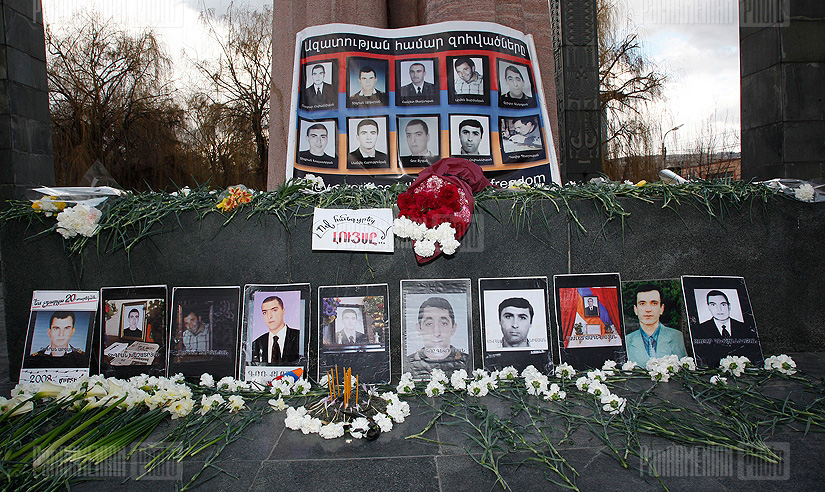
YEREVAN — Thousands of people gathered in central Yerevan on March 1 to commemorate the deaths of 10 people in 2008 during deadly postelection clashes between Armenian security forces and protesters. The rally at Freedom Square in Yerevan started with a minute of silence in memory of the victims.


“All of them died on their way towards peace, dignity and development of the country,” member of the Armenian National Congress Aram Manukyan said as he read out the names of the ten victims.


Speaking at the rally, leader of the Armenian National Congress Levon Ter-Petrosyan leveled harsh criticism at the government over what he described as its failed policies in different spheres, arguing that the current administration is not capable of carrying out the needed drastic reforms in the country.


march1victimsThe rally ended in a march staged towards the monument to Alexander Myasnikyan, the main venue where the deadly clashes of March 1-2, 2008 took place, where people laid flowers and lit candles.


Ten people were killed in the March 1-2, 2008 clashes between demonstrators demanding a rerun of a disputed presidential vote and security forces deployed in downtown Yerevan to quell the riot. The events followed 10 days of street protests organized by supporters of former president and current ANC leader Levon Ter-Petrosyan.


Armenia Commemorates Sixth Anniversary of March 1 Victims

Sports Review: Arthur Abraham Defeats Robert Stieglitz to Regain WBO Title

MAGDEBURG — Arthur Abraham defeated Robert Stieglitz by split decision on Saturday in their third bout, winning back the WBO super middleweight title he lost to his fellow German in March last year.In their first meeting Stieglitz won by fourth-round TKO to take Abraham’s WBO belt.


Arthur Abraham reclaimed the WBO super middleweight title he lost to Robert Stieglitz last year by winning a split decision on Saturday in their third bout.


In a 12-round rematch in Magdeburg, Germany, Judges Clark Sammartino of the United States and Paul Thomas of Britain scored it 114-111 and 115-110 for Abraham, respectively, while American Michael Pernick judged it 113-112 in favor of the defending champion.


Abraham, who beat Stieglitz by unanimous decision in their first bout in 2012 and lost on a technical knockout last year, improved to 39-4, with 28 knockouts.


“That was a real battle,” Abraham said. “Respect to Stieglitz; respect to my coach. We really saw a good fight. Of course I see myself as the winner. I won through my hard punches.”


Abraham will return to action on May 31st, when he will make the first defense of his newly won title. The opponent and venue will be announced later.


Mkhitaryan-NuernbergHenrikh Mkhitaryan’s Goals Help Borussia Dortmund Beat FC Nürnberg and FC Zenit Saint Petersburg


Borussia Dortmund’s Henrikh Mkhitaryan was delighted to have helped his team return to winning ways after the 3-0 win against FC Nürnberg. Mkhitaryan was credit with an assist and a goal that moved Dortmund into second place in the Bundesliga after this win.


Germany defender Mats Hummels marked his first game in four weeks by netting from close range to open the scoring. Robert Lewandowski then tapped home to double the hosts’ lead after Henrikh Mkhitaryan’s pass.


Mkhitaryan and Nürnberg keeper Raphael Schafer were locked in a fascinating battle throughout, and the midfielder finally got the better of the visiting goalkeeper seven minutes from time, sliding home after a delightful through pass from substitute Jonas Hofmann.


On Tuesday Dortmund defeated FC Zenit Saint Petersburg 4-2 in UEFA Champions League round-of-8 first-leg away match.


Armenian international Mkhitaryan opened the score in the fourth minute as he finished from the centre of the penalty area following Jonas Hofmann’s cross.


 Armenia-team-5Armenia to Play Russia in a Friendly Match on March 5


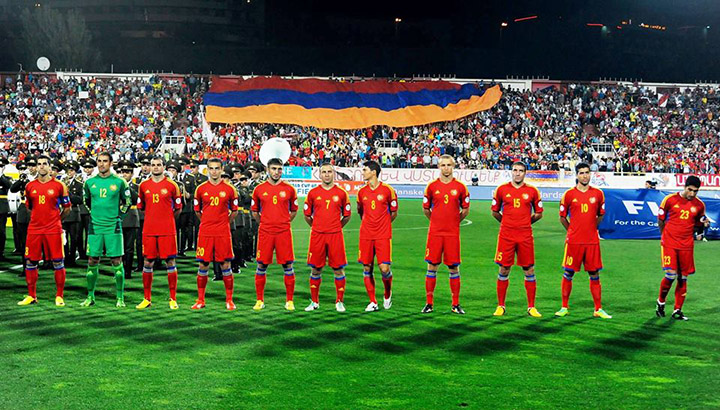
The national football teams of Armenia and the Russian Federation will play a friendly match on March 5 in Krasnodar, Russia. The match will be televised live on Armenia TV.


Armenia and Russia are 30th and 22nd, respectively, in the new International Federation of Association Football (FIFA) World Ranking.


This will be the first friendly game between the two national squads. The two teams have faced each other four times in official tournaments. Russia defeated Armenia three times and one match ended in a scoreless draw.


Armenia will face Algeria in a friendly match that will take place in Stade de Geneve stadium in Geneva, Switzerland on May 31. Algeria is currently ranked 26th in FIFA World Ranking.


The Armenian national football team will play a friendly charity match against Germany on June 6 in Mainz, Germany.


Russia , Algeria and Germany have all qualified to play in World cup 2014 in Brazil.


Sports Review: Arthur Abraham Defeats Robert Stieglitz to Regain WBO Title

New Book by George Bournoutian: "From Tabriz to St. Petersburg: Iran’s Mission of Apology to Russia in 1829"

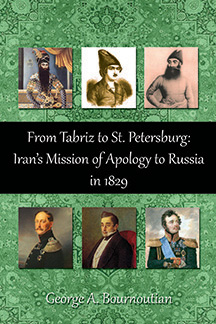
BournoutuianbookCOSTA MESA, CA — Mazda Academic Press announces the publication of Dr. George Bournoutian’s new book: From Tabriz to St. Petersburg: Iran’s Mission of Apology to Russia in 1829.


This original volume, based solely on Persian and Russian primary sources, describes the year-long journey of the Iranian delegation to Russia to apologize for the murder of the Russian ambassador and the massacre of the entire staff of the Russian embassy (save one) by an angry mob in Tehran in February of 1829. The incident, which was sparked when an Armenian man and two Armenian women who sought refuge or who were brought to the Russian Embassy in Tehran, endangered the recent peace between Russia and Iran following the Second Russo-Iranian War of 1826-1828.


The Iranian representatives left Tabriz in two groups: the first in March and the second in May 1829. The first group went through Nakhichevan, Yerevan, Sardarabad, Etchmiadzin, Gyumri, Spitak, and Stepanavan to Tiflis. The second group went through Karabagh and Ganja to Tiflis From there the two groups united and went on to Moscow and from there to St. Petersburg, where they stayed for more than two months.


The mission, headed by Khosrow Mirza, the 16-year-old seventh son of Crown Prince ‘Abbas Mirza, carried letters of apology and gifts to the Tsar. It returned on February 27, 1830, after successfully accomplishing its task. The young Prince had not only charmed the Tsar, the royal family and the nobility, but had also managed to reduce Iran’s war indemnity payment to Russia. His skillful diplomacy saved Iran from Russian retaliation, strengthened Russo-Iranian ties, and lessened the British influence in Iran.


The present study, utilizing Persian and Russian contemporary accounts, is a detailed and daily account of the long journey and experiences of the Iranian delegation in Armenia and Georgia, its stay in the various Russian cities such as Vladikavkaz, Stavropol, Voronezh, Moscow, and especially its long stay in St. Petersburg. The Iranians met a number of Armenian officials in the service of Russia and visited the Lazarian Institute. It should serve as a primary source on Russo-Iranian relations in the first third of the 19th century.


The 360-page book contains 8 special maps, photos, facsimiles of the original manuscripts and can be obtained from Mazda Academic Press.


New Book by George Bournoutian: "From Tabriz to St. Petersburg: Iran’s Mission of Apology to Russia in 1829"